When storms, floods or major incidents leave several households unable to stay at home, alternative accommodation can quickly become an operational bottleneck. Claims teams must find suitable properties, keep policyholders informed and control costs while demand is still rising.
The best response starts before the booking queue builds. A simple surge plan, clear ownership and one shared accommodation workflow can help teams move faster without losing sight of suitability or customer care.
Key takeaways
Act when warning signals and claim volumes begin to change, not when the team is already overwhelmed.
Triage each household by urgency and individual requirements.
Keep searches, supplier responses, decisions, bookings and costs in one workflow.
Plan extension reviews from the start of every stay.
Measure speed, but never at the expense of suitability or fair customer outcomes.
Why surge events make accommodation harder
A surge event happens when the volume, urgency or location of claims exceeds a team's normal accommodation capacity. It may follow flooding, storms, fires, escape-of-water incidents or another event affecting several homes.
The difficulty is not simply finding more properties. Teams may face:
tight local accommodation supply;
disrupted transport or restricted search areas;
households needing accessible accommodation;
pets, parking, schools or care networks to consider;
uncertain repair dates; and
pressure for frequent policyholder updates.
The FCA requires insurers to handle claims promptly and fairly, provide reasonable guidance and keep customers appropriately informed. A surge does not remove those responsibilities; it makes an organised process more important.
The financial environment is also significant. The Association of British Insurers reported £6.1 billion in UK property-insurance claims during 2025, including £1.2 billion connected with weather-related property damage.
Prepare before demand starts to peak
Start with agreed triggers, responsibilities and escalation routes. The Met Office uses impact-based warnings, while Environment Agency flood alerts can add useful local context in England.
A practical trigger plan could include:
Relevant yellow warning: review exposed areas, supplier coverage and staffing.
Amber warning or concentrated claims: activate a surge queue and daily capacity review.
Several urgent displacement cases: prioritise household triage and suitable-property searches.
Local supply tightening: widen the search radius under agreed rules and escalate exceptions.
Repair dates moving: review extensions before current bookings approach expiry.
These are examples rather than universal thresholds. Each insurer should adapt them to its portfolio, policy wording, operating model and governance requirements.
Before starting a search, capture the essential information once:
household size and preferred location;
accessibility or support requirements;
pets and parking;
school, work, treatment or care journeys;
expected duration;
budget authority; and
the policyholder's preferred contact method.
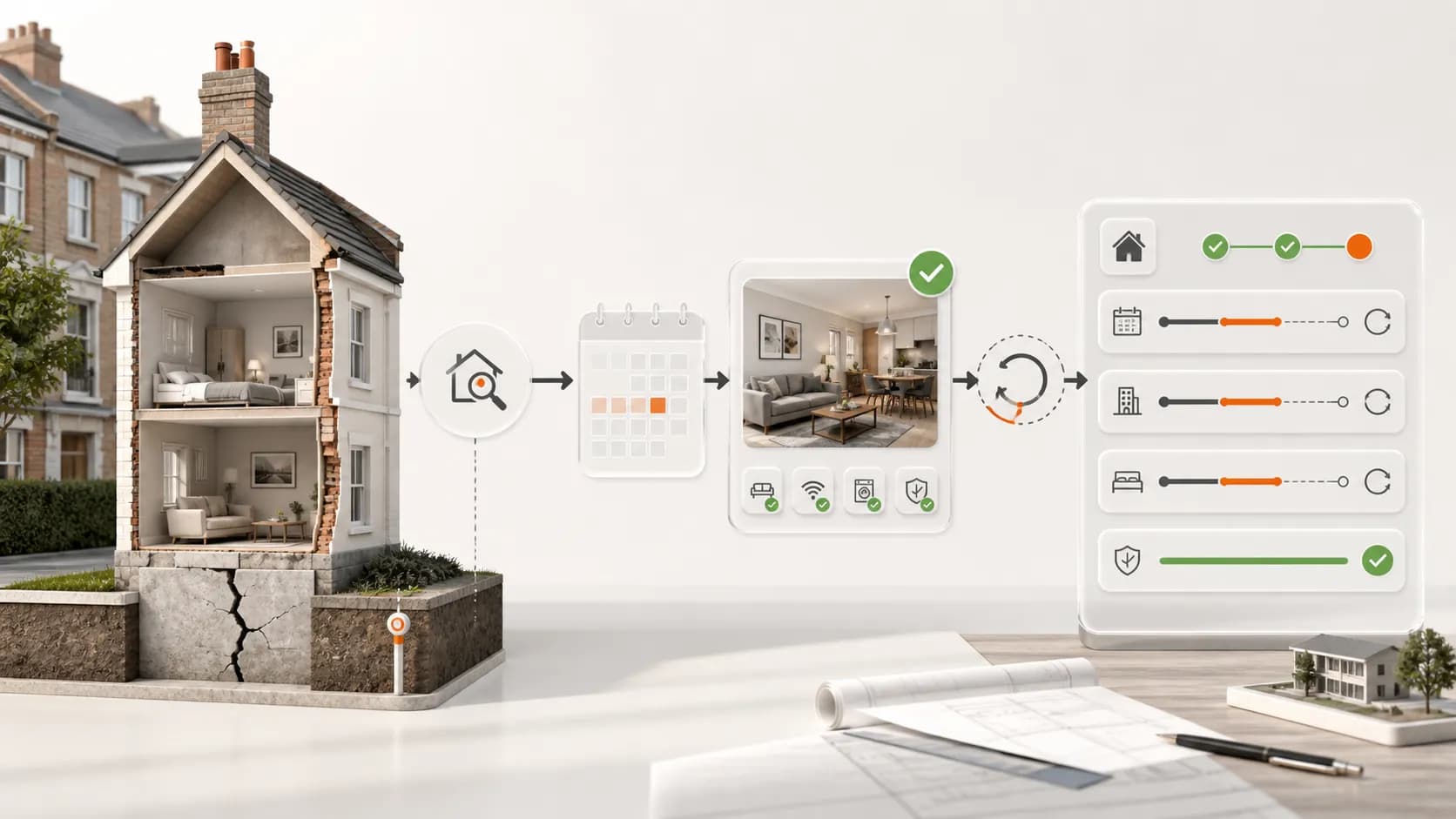
A six-step accommodation workflow
1. Monitor demand and impact signals
Bring official warnings, incoming claims and geographic concentrations into one operational view. The aim is to recognise when normal case handling is turning into a queue-management problem.
The surge lead should be able to see:
affected regions;
open accommodation cases;
households still waiting for a suitable option; and
locations where response times or supply are deteriorating.
2. Triage households consistently
Separate immediate emergency needs from the accommodation search, then record the household's essential requirements. A consistent approach helps prevent the loudest request from automatically being treated as the most urgent.
Human interaction must remain available. Accessibility, medical treatment, infants, caring responsibilities or other individual circumstances may require a different search radius or decision route.
3. Search live supply
During a surge, long email chains and repeated telephone calls are difficult to control. Claims teams need live availability where possible and a clear way to collect supplier responses when instant options are unavailable.
The VivreStays insurer platform allows teams to create booking requests, shortlist live options and manage supplier enquiries centrally. Search requirements can then be separated into:
non-negotiable needs, such as accessibility or household capacity;
important preferences, such as parking or proximity to school; and
exceptions requiring approval, such as a wider radius or different property type.
4. Share suitable options
Speed only helps when policyholders receive suitable and understandable choices. Keep the shortlist manageable and explain the property type, location, facilities, dates and any important conditions.
VivreStays supports sharing shortlisted options with policyholders. Recording what was offered, selected and approved also creates a clearer decision trail when cases move between handlers.
5. Confirm and manage the stay
Once an option is accepted, update the central case record rather than beginning another disconnected email chain. Keep dates, costs, approval status, supplier details and communications visible to the relevant team.
Accommodation management continues after confirmation. Teams still need to track:
booking changes;
actions and exceptions;
repair updates;
policyholder communications; and
the next review date.
For a closer look at operational speed, read Reducing Claims Cycle Time Through Live Accommodation Availability.
6. Review extensions early
Do not let an expiring booking create a new emergency. Set the review date at the beginning of the stay and compare the latest repair timetable with the cost and disruption of extending or moving.
VivreStays keeps extension activity alongside the original booking and reporting information. That gives claims teams more time to preserve continuity where appropriate while maintaining visibility of dates and costs.
Measure what helps the team act
A short surge dashboard is more useful than dozens of measures nobody owns. Consider tracking:
time to the first suitable option;
time to booking confirmation;
cases with no suitable option and their age;
bookings approaching review without an extension decision;
cost variance against recorded authority;
avoidable household moves; and
supplier response coverage by region.
These are management indicators, not customer promises. A quick first option followed by repeated moves may be worse than a slightly longer search that produces a suitable, stable placement.
After the event, review where supply tightened, which requirements caused exceptions and when demand first exceeded capacity. Turn those findings into specific changes to the surge plan and supplier network.
Where software adds control
Software cannot create unlimited local supply or decide what is fair for an individual household. It can reduce avoidable administration and make the next action clearer.
The strongest approach connects the full journey:
booking request;
live search and supplier enquiries;
option sharing;
confirmation;
extension management; and
reporting.
VivreStays emergency housing supports rapid placements and changing stay requirements. A shared workflow can also give operations leaders a clearer view of workload, costs and unresolved exceptions.
Frequently asked questions
What is an insurance surge event?
It is a period when the volume, urgency or geographic concentration of claims exceeds normal handling capacity. Each insurer should use its own agreed definition and activation criteria.
When should an accommodation surge plan be activated?
Use a combination of official warnings, portfolio exposure, claim notifications, local supply and internal capacity. A warning colour alone should not dictate every operational decision.
How should vulnerable policyholders be prioritised?
Follow established vulnerability, data-protection and claims procedures. Capture only the information needed to find suitable accommodation and retain a clear route for human escalation.
Can software guarantee suitable accommodation?
No. It can improve availability searches, supplier communication and workflow visibility, but suitability still depends on the household, available supply, policy terms and professional judgement.
Why plan extensions during the initial booking?
Repair timetables often change. An early review date gives the team time to compare continuity, cost and availability before the booking expires.
Bring surge accommodation into one workflow
VivreStays helps insurers search live availability, manage supplier responses, share suitable options, confirm bookings and control extensions in one platform. If your surge process still relies on fragmented inboxes and spreadsheets, request a VivreStays demo to explore a more controlled approach.
Sources