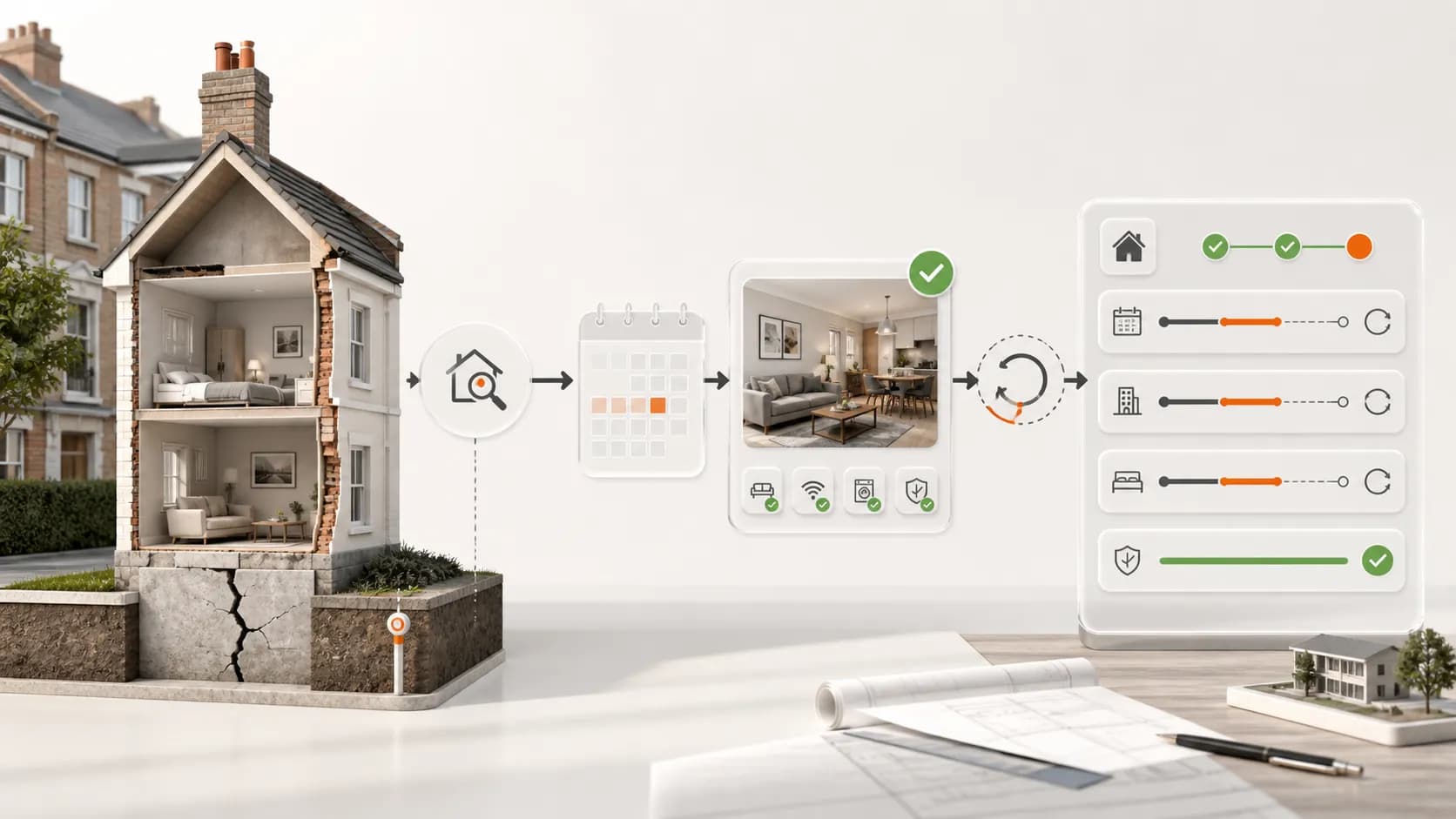
Subsidence claims can create unusually long and uncertain accommodation needs. Claims teams do not have to wait until the move becomes urgent: they can schedule the likely stay in advance, secure a suitable long-term option and manage later date changes in one controlled workflow.
This article gives claims teams a practical framework for doing that. It is operational guidance, not legal advice, and each decision must follow the policy wording, expert evidence and the insurer’s own authority limits.
Key Takeaways
Start planning as soon as you know when the move is likely to happen and what the household needs.
See the first booking as the start of an ongoing placement, not the final end date.
Choose accommodation based on the household’s needs and how long they may need to stay.
Review the booking well before the accommodation end date.
Keep all extensions, approvals, rates and policyholder updates linked to the same booking.
Have a backup option ready before accommodation becomes urgent.
Use claim data to spot delays, unnecessary moves and rising costs.
Why Subsidence Accommodation Needs a Different Plan
Subsidence claims can take time and may not follow a clear timeline. Engineers often need to monitor the property before deciding on a long-term solution.
This means accommodation dates can change. A short booking may work at first, but repeatedly extending unsuitable accommodation can cause disruption for the household and increase costs.
ABI data published in May 2026 put the average household subsidence claim at £17,820 in the first quarter of 2026, 9% above the 2025 comparison. This covers the wider claim, not accommodation alone, but shows why long cases need oversight.
Schedule the Placement Before It Becomes Urgent
Booking early gives the team more time to make the right choice. Once the likely move date, location and household needs are clear, they can look at longer-term options rather than waiting for repairs to start.
Dates can change, so the booking should be flexible and reviewed regularly rather than treated as a one-off reservation.
VivreStays allows teams to plan placements in advance, compare longer-term options and work with vetted suppliers. It brings availability, enquiries, bookings, approvals, extensions and reporting into one place.
Build the Placement Around the Claim Timeline
Teams do not need a perfect completion date. They need to record what is known, what is uncertain and when the next decision will be made.
Claim stage | Accommodation decision | Control to record |
|---|---|---|
Initial assessment | Choose a safe, practical first placement | Household needs, authority, dates and contact preference |
Investigation or monitoring | Check whether the property suits a longer stay | Review date, likely scenarios and supplier flexibility |
Repair scope agreed | Align the stay with the working programme | Expected milestones, budget position and approval owner |
Works in progress | Extend early or prepare an alternative | Updated end date, rate, availability and household impact |
Return home | Confirm the property is ready before ending the stay | Handover evidence, final dates and closed costs |
The Financial Ombudsman Service’s subsidence guidance lists slow resolution, poor communication and inadequate alternative accommodation among the complaints it sees. A review cycle can stop booking decisions being left until the last moment.
Start With a Complete Household Brief
Before searching, record the household size, accessibility needs, pets, parking, essential travel, furniture, utilities and preferred contact method.
Refresh the brief at each review because needs can change. The seven-check policyholder accommodation framework provides a starting point.
Plan for More Than One Duration
Use a flexible date range: the earliest likely end date, expected end date and a longer backup date.
This helps compare different accommodation options and plan for possible delays.
Agree the Review Trigger at Booking
Each placement should have a clear owner and review date. Review it regularly based on updates to the claim, repairs or before the stay ends.
Review early, while there are still good accommodation options available.
Use an Extension-First Workflow
Extension-first does not mean extending every stay. It means reviewing each placement early, with the right information.
Open the review. Check the current end date, notice period and next claim milestone.
Update the claim timeline. Get the latest information from the loss adjuster, surveyor or repair team.
Reconfirm household needs. Check the property is still suitable and whether anything has changed.
Check continuity. Confirm the property is available and check the new rate and terms.
Compare alternatives. Look at the cost and disruption of moving, not just the nightly rate.
Approve and communicate. Record who made the decision, the dates and the policyholder update.
Set the next review. Agree the next review date as soon as the extension is confirmed.
VivreStays’ subsidence accommodation workflow VivreStays supports advance planning, long stays, extensions and keeping everything in one booking record.
Claims teams can plan accommodation earlier and keep the booking history, approvals and dates together, rather than managing everything through separate emails.
Keep Suitability Live During a Long Stay
A property that works for two weeks may not work for six months. Over time, things like cooking, laundry, accessibility, school travel and support networks become more important.
The FCA’s review of home and travel claims handling highlights flexibility where vulnerability may be affected by remaining in a property during repairs. Keep a human route for individual circumstances.
FCA ICOBS 8 Requires clear communication, fair handling and regular updates. A clear extension timetable helps keep everyone informed.
Control Cost Without Creating Unnecessary Moves
Look beyond the current accommodation rate. A move can add transport, overlap, deposits, removals, admin and disruption costs.
Compare the full cost of each option:
● Cost of extending the current property
● Cost of moving, including any overlap
● Likely length of the next placement
● Impact on school, work, care and treatment journeys
● Approval time and operational effort
● Risk of another short booking leading to another urgent extension
Keep the rate, fees, approval and reason in one record. VivreStays’ platform for insurers publicly includes extensions, reporting, approvals and credit facilities within the booking workflow.
Prepare a Contingency Before Continuity Fails
Sometimes the current property cannot be extended because availability, household needs or dates change.
Set a backup point. If the extension is not confirmed, search for alternatives and share the options.
Keep the booking history and reason for the move clear.
The aim is to avoid last-minute emergencies caused by delays, unclear ownership or missing information.
Frequently Asked Questions
How long does alternative accommodation last in a subsidence claim?
There is no standard duration. It depends on the policy, whether the home is habitable, the investigation and monitoring required, the repair solution and progress of the works. Claims teams should use supported working dates and review them regularly.
When should an extension review begin?
Begin early enough to confirm availability, obtain updated claim information, secure approval and speak to the household before the end date. The right lead time depends on the booking terms, local supply and the complexity of the claim.
Is keeping the household in the same property always best?
No. Continuity can reduce disruption, but the current property must remain suitable, available and proportionate to the expected stay. Compare extension and relocation using total cost and household impact.
What should be recorded for each extension?
Record the old and new dates, updated rate and terms, approval owner, reason, household confirmation, supplier response, policyholder communication and next review date.
Can VivreStays manage long subsidence placements?
The live VivreStays site states that the platform supports long-term subsidence bookings, extensions against the original booking, central supplier responses and one record of dates, status and history. Exact workflow, integration and commercial terms should be confirmed during a demonstration.
Plan the Next Subsidence Placement Earlier
If subsidence cases are reaching the booking team too late, VivreStays can demonstrate how to schedule likely placements in advance and manage live accommodation options, enquiries, approvals, extensions and reporting in one workflow. Request a VivreStays demonstration using a real example from your current process.
Sources